

What Was The Chemical Makeup Of The Earth's Atmosphere During The Ordovician Period
| Paleozoic era (542 - 251 mya) | |||||
|---|---|---|---|---|---|
| Cambrian | Ordovician | Silurian | Devonian | Carboniferous | Permian |
| Ordovician period 488 - 444 million years ago | |
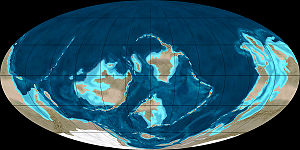 | |
| Earth's land and bounding main distribution in the Middle Ordovician epoch about 466 meg years ago. During the Ordovician's 45 one thousand thousand years, sea level ranged from 180 to 220 to 140 meters (590 to 722 to 459 feet) above the current level. | |
| Central events in the Ordovician Period -490 — – -485 — – -480 — – -475 — – -470 — – -465 — – -460 — – -455 — – -450 — – -445 — – Paleozoic era Key events of the Ordovician period. | |
The Ordovician period is an interval of almost 44 million years defined on the geologic timescale as spanning roughly from 488 to 444 million years ago (mya) and being noteworthy for both beginning and ending with extinction events, while besides being a source of abundant fossils and in some regions major reservoirs of oil and gas. It is the second of 6 periods of the Paleozoic era, lying between the before Cambrian period and the afterwards Silurian period.
In the seas, which covered much of the continental land mass, i prominent form of life was the cephalopods, a group of mollusks related to the squid and octopus, while trilobites and brachipods (looking externally somewhat similar to clams) were common, and diverse other invertebrate forms complemented the widespread sponges and corals every bit red and green algae floated in the water. The chordates were represented by the ostrachoderms, an early jawless fish.
The extinction event marking the get-go of the Ordovician menstruation is considered a minor ane, just the Ordovician-Silurian extinction consequence, which ends the menses, wiped out near 60 percentage of marine genera. Geophysical indicators for the period are consistent with the faunal extinction record.
Global average temperature held adequately abiding through more than the first half of the flow, but declined precipitously toward the end of the period as an interval marked past glaciation began. Sea level was significantly college than today when the period began and information technology rose even college through more than than the first half of the period before dropping some 80 meters (263 anxiety) toward the end of the catamenia as water ice accumulated on the country. The Ordovician temper had well-nigh seventy pct every bit much oxygen and nearly 1500 per centum equally much carbon dioxide as today's temper.
The Ordovician, named after the Welsh tribe of the Ordovices, was defined by Charles Lapworth, in 1879, to resolve a dispute between followers of Adam Sedgwick and Roderick Murchison, who were placing the aforementioned rock beds in northern Wales into the Cambrian and Silurian periods, respectively. Recognizing that the fossil fauna in the disputed strata were different from those of either the Cambrian or the Silurian periods, Lapworth placed them in a period of their own.
Contents
- ane Ordovician subdivisions
- ii Ordovician paleogeography
- 3 Ordovician life
- three.1 Ordovician fauna
- 3.two Ordovician flora
- three.3 Fungal life
- 4 End of the Ordovician
- five Notes
- half dozen References
- 7 Credits
Ordovician subdivisions
Afterwards Charles Lapworth starting time defined the Ordovician period in 1879 in the Britain, other areas of the earth accepted it quickly, while its acceptance came last to the United Kingdom. The Ordovician menstruum received international sanction in 1906, when it was adopted as an official menstruation of the Paleozoic era by the International Geological Congress. Further elaboration of the fossil evidence provided the footing for subdividing the period.
The Ordovician Catamenia is normally broken into Early (Tremadoc and Arenig), Middle (Llanvirn, subdivided into Abereiddian and Llandeilian), and Late (Caradoc and Ashgill) epochs. The corresponding rocks of the Ordovician System are referred to as coming from the Lower, Heart, or Upper part of the column. The faunal stages (subdivisions based on fossil show) from youngest to oldest are:
- Late Ordovician: Ashgill epoch
- Hirnantian/Gamach
- Rawtheyan/Richmond
- Cautleyan/Richmond
- Pusgillian/Maysville/Richmond
- Middle Ordovician: Caradoc epoch
- Trenton
- Onnian/Maysville/Eden
- Actonian/Eden
- Marshbrookian/Sherman
- Longvillian/Sherman
- Soundleyan/Kirkfield
- Harnagian/Rockland
- Costonian/Blackness River
- Middle Ordovician: Llandeilo epoch
- Chazy
- Llandeilo
- Whiterock
- Llanvirn
- Early Ordovician: Arenig epoch
- Cassinian
- Arenig/Jefferson/Castleman
- Tremadoc/Deming/Gaconadian
Ordovician paleogeography
Sea levels were loftier during the Ordovician period, ranging from 180 meters (590 feet) above modern sea level at the beginning to a summit in the tardily Ordovician of 220m (722ft) and and so falling rapidly near the end of the menstruation to 140m (459ft) (Huq 2008). Ancillary with the drop in sea level was drop in the global mean temperature of nearly 10 degrees Celsius (18 degrees Fahrenheit).
During the Ordovician, the southern continents were collected into a unmarried continent called Gondwana. Gondwana started the period in equatorial latitudes and, equally the period progressed, drifted toward the South Pole. As with Northward America and Europe, Gondwana was largely covered with shallow seas during the Ordovician. Shallow clear waters over continental shelves encouraged the growth of organisms that deposit calcium carbonates in their shells and hard parts. Panthalassic Bounding main covered much of the northern hemisphere, and other minor oceans included Proto-Tethys, Paleo-Tethys, Khanty Ocean (which was closed off by the Late Ordovician), Iapetus Ocean, and the new Rheic Ocean. By the end of the menstruation, Gondwana had neared or approached the pole and was largely glaciated.
The Early on Ordovician was thought to exist quite warm, at least in the tropics.
Ordovician rocks are chiefly sedimentary. Because of the restricted expanse and low height of solid land, which set limits to erosion, marine sediments that brand up a large office of the Ordovician system consist chiefly of limestone. Shale and sandstone are less conspicuous.
A major mountain-building episode was the Taconic orogeny, which had gotten well nether way in Cambrian times and continued into the Ordovician menstruation.
Ordovician life
Ordovician fauna
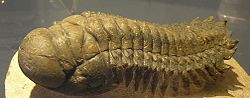
In what was to become North America and Europe, the Ordovician period was a time of shallow continental seas rich in life. Trilobites and brachiopods in particular were numerous and diverse. The earth's largest trilobite, Isotelus rex, was found in 1998, by Canadian scientists in Ordovician rocks on the shores of Hudson Bay. The outset bryozoa appeared in the Ordovician as did the first coral reefs—although solitary corals dating back to at least the Cambrian have been plant. Mollusks, which had also appeared during the Cambrian, became common and varied, peculiarly bivalves, gastropods, and nautiloid cephalopods.
It was long thought that the first truthful chordates appeared in the Ordovician period in the course of fossils of the fish-like Ostracoderms found in strata traced to the Centre Ordovician (Gregory 1935). More recently, all the same, fossils of other fish-similar creatures, the 530-one thousand thousand-twelvemonth-quondam Early Cambrian fossil dubbed Haikouella and so the 515-million-year-old middle Cambrian brute Pikaia have been promoted as the world's earliest chordate (Heeren 2000).
The very beginning jawed fish appeared in the Tardily Ordovician epoch and now-extinct worm-shaped marine animals called graptolites thrived in the oceans. Some cystoids (archaic stalked marine animals related to modern starfish and sand dollars) and crinoids (chosen bounding main lilies and feather stars; likewise related to starfish and sand dollars) appeared.
Ordovician flora
Green algae were mutual in the Ordovician and Late Cambrian (perhaps before). Plants probably evolved from green algae. The first terrestrial plants appeared in the form of tiny plants resembling liverworts. Fossil spores from land plants have been identified in uppermost Ordovician sediments.
Fungal life
The first state fungi probably appeared in the Latest Ordovician, following the appearance of plants. Marine fungi were abundant in the Ordovician seas, plainly decomposing animal carcasses, and other wastes.
End of the Ordovician
- Main article: Ordovician-Silurian extinction events.
The Ordovician catamenia came to a close in a serial of extinction events that, taken together, comprise the 2d largest of the five major extinction events in World'due south history in terms of percentage of genera that went extinct. The only larger ane was the Permian-Triassic extinction issue.
The extinctions occurred approximately 444-447 million years ago and mark the boundary between the Ordovician and the following Silurian Catamenia. At that time, all complex multicellular organisms lived in the bounding main, and near 49 percentage of genera of animate being disappeared forever; brachiopods and bryozoans were decimated, along with many of the trilobite, conodont, and graptolite families.
Melott et al. (2006) take suggested a x-second gamma ray burst could have been responsible, destroying the ozone layer and exposing terrestrial and marine surface-dwelling life to radiation. Most scientists continue to concord that extinction events are complex events with multiple causes.
The virtually normally accustomed theory is that these extinction events were triggered by the onset of an ice age, in the Hirnantian faunal stage that ended the long, stable greenhouse conditions typical of the Ordovician. The ice historic period was probably non as long-lasting as one time idea; study of oxygen isotopes in fossil brachiopods shows that information technology was probably no longer than 0.5 to i.v million years (Stanley 1999). The effect seemingly was preceded by a fall in atmospheric carbon dioxide (from 7000 ppm to 4400 ppm), which selectively affected the shallow seas where almost organisms lived. As the southern supercontinent Gondwana drifted over the South Pole, water ice caps formed on it, which have been detected in Upper Ordovician stone strata of North Africa and then-adjacent northeastern South America, which were south-polar locations at the time.
Glaciation locks upward water from the bounding main, and the interglacials complimentary information technology, causing ocean levels repeatedly to drop and rise. The vast shallow intra-continental Ordovician seas withdrew, which eliminated many ecological niches. Information technology then returned carrying macerated founder populations defective many whole families of organisms, then withdrew once more with the adjacent pulse of glaciation, eliminating biological diverseness at each modify (Emiliani 1992). Species limited to a single epicontinental sea on a given landmass were severely affected (Stanley 1999). Tropical lifeforms were hit particularly hard in the showtime wave of extinction, while cool-h2o species were hit worst in the second pulse (Stanley 1999).
Surviving species were those that coped with the changed conditions and filled the ecological niches left by the extinctions.
At the end of the second upshot, information technology is speculated that melting glaciers caused the sea level to rise and stabilize again. The rebound of life's diversity with the permanent re-flooding of continental shelves at the onset of the Silurian saw increased biodiversity within the surviving orders.
Notes
- ↑ Wellman, C.H., Gray, J. (2000). The microfossil record of early land plants. Phil. Trans. R. Soc. B 355 (1398): 717–732.
References
ISBN links support NWE through referral fees
- Gregory, Westward. K. "On the evolution of the skulls of vertebrates with special reference to heritable changes in proportional diameters (anisomerism)." Proceedings of the National Academy of Sciences 21(i):1-8, 1935.
- Heeren, F. Challenging fossil of a little fish The Boston Globe. May 30, 2000. Retrieved September 22, 2007.
- Huq, B.U. "A Chronology of Paleozoic Body of water-Level Changes." Science 322: 64-68, 2008.
- International Commission on Stratigraphy (ICS). Retrieved September 22, 2007.
- Melott, A., et al. Did a gamma-ray burst initiate the late Ordovician mass extinction? International Journal of Astrobiology iii:55, 2004.
- Ogg, J. Overview of Global Boundary Stratotype Sections and Points (GSSP's). 2004. Retrieved September 22, 2007.
- Stanley, Due south. Thousand. Earth System History. New York: W.H. Freeman and Company, 1999. ISBN 0-7167-2882-6.
Credits
New World Encyclopedia writers and editors rewrote and completed the Wikipedia article in accordance with New World Encyclopedia standards. This commodity abides by terms of the Creative Commons CC-by-sa iii.0 License (CC-by-sa), which may be used and disseminated with proper attribution. Credit is due nether the terms of this license that can reference both the New Globe Encyclopedia contributors and the selfless volunteer contributors of the Wikimedia Foundation. To cite this article click hither for a list of acceptable citing formats.The history of earlier contributions by wikipedians is accessible to researchers here:
- Ordovician history
The history of this commodity since information technology was imported to New World Encyclopedia:
- History of "Ordovician"
Note: Some restrictions may apply to use of individual images which are separately licensed.

What Was The Chemical Makeup Of The Earth's Atmosphere During The Ordovician Period,
Source: https://www.newworldencyclopedia.org/entry/Ordovician
Posted by: pitrefith1963.blogspot.com
0 Response to "What Was The Chemical Makeup Of The Earth's Atmosphere During The Ordovician Period"
Post a Comment